How Modular Wire Mesh Systems Reduce Construction Costs
December 2, 2025
Common Mistakes Contractors Make When Specifying Wire Mesh Partitions
January 14, 2026
Top 5 Security Requirements You Must Meet When Designing Secure Storage Areas
Designing secure storage areas requires careful attention to functional, operational, and compliance requirements, whether the space protects high-value inventory, sensitive documents, controlled equipment, or tenant storage. Overlooking these requirements early can result in costly redesigns, failed inspections, or vulnerabilities that compromise safety and security.
Secure storage areas must meet five core requirements: forced-entry resistance, controlled access, visibility, life-safety compliance, and long-term adaptability. Modular wire mesh systems are uniquely suited to meet all five while reducing cost, simplifying approvals, and supporting future reconfiguration.
Below are the five essential security requirements every secure storage area should meet, supported by current industry standards and verified best practices.
1. Physical Strength & Forced-Entry Resistance
At its most fundamental level, secure storage must prevent unauthorized access through robust construction that resists forced entry attempts.
Key Construction Standards:
Wire Gauge and Mesh Specifications:
- Standard industrial applications typically use 10-gauge wire with 2″ x 1″ rectangular or 2″ x 2″ welded mesh patterns
- For high-security environments requiring extreme protection, 6-gauge wire with 2″ x 2″ woven mesh provides the strongest available option
- Pharmaceutical and medical applications often specify 3/4″ x 3/4″ 10-gauge mesh, tight enough to prevent pill bottles from passing through
Structural Components:
- Panel vertical frames constructed from 1-¼” x ½” x ⅛” channels with mortised and tenoned joints
- Wire mesh welded into 1¼” x 1¼” x ⅛” hot-rolled angle frames with flat stiffener bars for larger panels
- 2″ square, 14-gauge steel tube posts with 3/8″ mounting hardware and welded base plates
Security Design Features:
- All assembly hardware positioned on the secured side, inaccessible from outside
- Woven wire panels offer resistance to climbing with no easy foot or handholds
- Individual damaged panels can be removed and replaced without affecting the entire system
Compliance Considerations: Wire mesh partition systems should conform to ANSI B11.9 and RIA TR R15.406-2014 standards for safety and regulatory compliance
Traditional drywall or light framing offers minimal security against determined intrusion. Wire mesh partition systems provide high visibility while maintaining structural strength, making forced entry significantly more difficult without sacrificing supervision or airflow.
2. Controlled Access & Locking Systems
A secure space is only as effective as its access control mechanisms.
Best Practices Include:
Lock Types and Standards:
- GSA-approved locks including the Kaba Mas CDX-07, CDX-08, CDX-09, and CDX-10 models for secure rooms and vaults
- Available options include padlock hasps, mortise cylinder locks, magnetic locks, keyless entry systems, and electric strikes
- Five-button access locks, deadbolts, electromagnetic locks, coded card readers, and electric strike locks for varying security levels
Access Control Principles:
- Secure storage areas should only be accessible to authorized persons, with operational and security procedures limiting access to the minimum number necessary
- Clearly defined entry points with no unintended access paths
- Compatibility with key control systems, badge access, or monitored locking systems
Monitoring Requirements: All access points to secure storage areas should be continuously monitored via video surveillance and intrusion detection systems
For facilities managing multiple users, departments, or tenants, controlled access ensures that only authorized individuals can enter specific areas, reducing liability and improving accountability.
3. Visibility for Monitoring & Safety
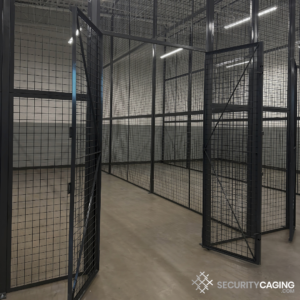
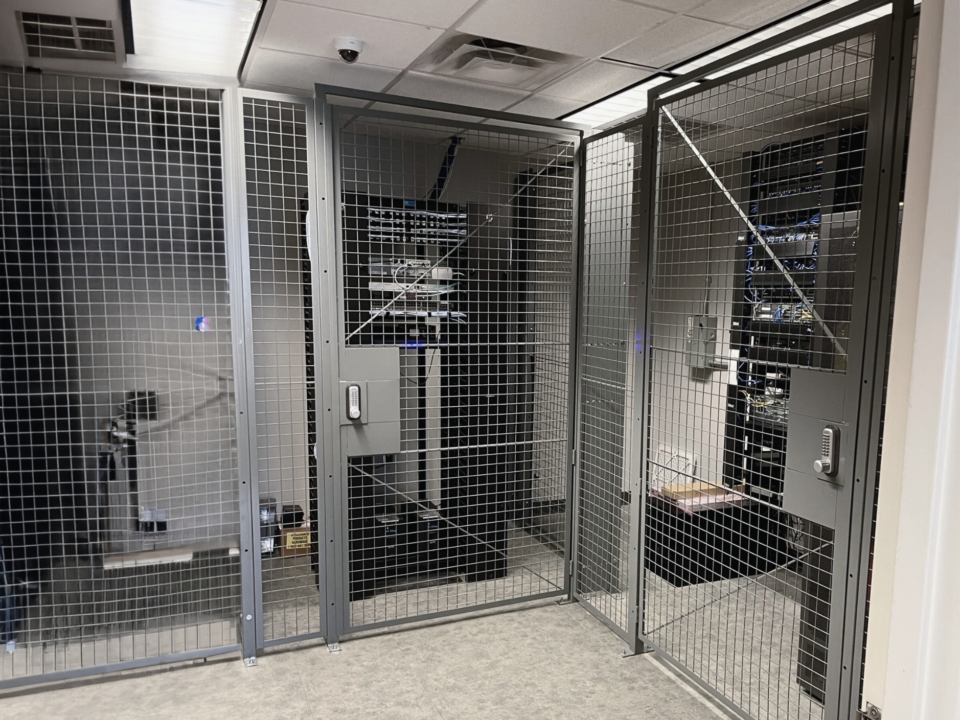
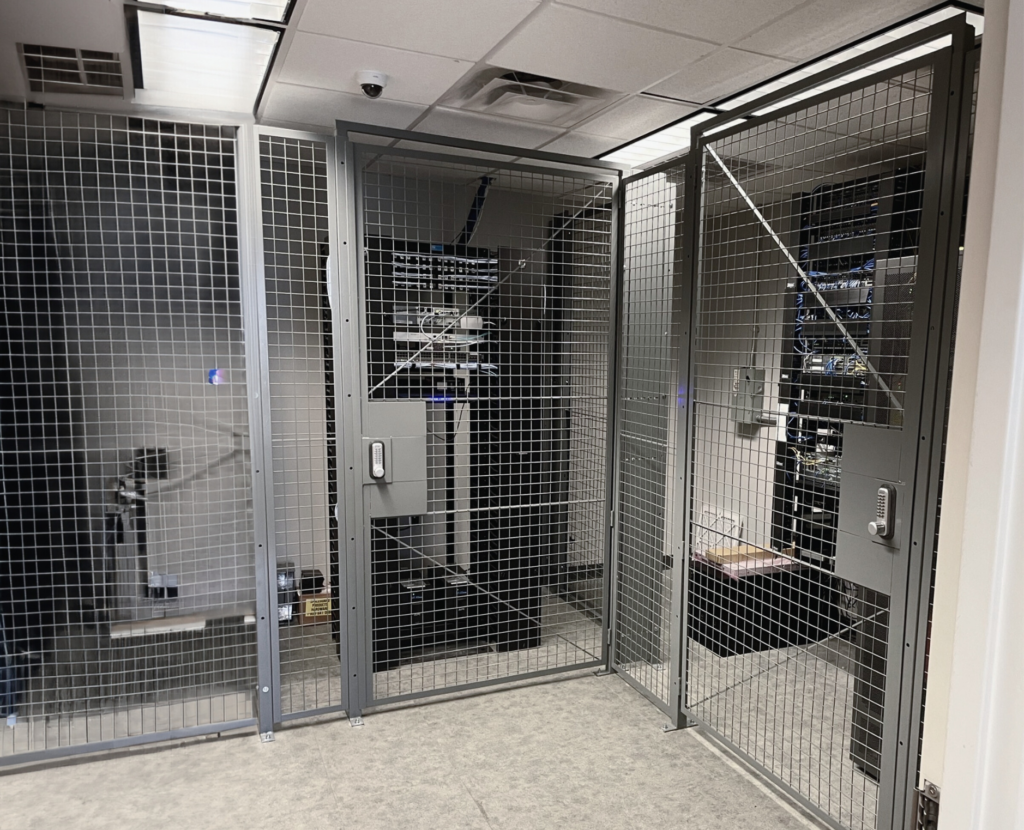
Modular wire mesh partitions provide controlled access, full visibility, and airflow for secure storage areas without compromising code compliance.
One of the most overlooked security requirements is visibility. Secure storage areas should allow staff, security personnel, or cameras to monitor activity visually without opening or entering the space.
Why Visibility Matters:
Security Benefits:
- Supports surveillance and loss prevention efforts
- Enables remote monitoring of restricted areas
- Reduces blind spots and concealed activity
- Wire cages allow both visibility and airflow, enabling monitoring of inventory and other factors inside while taking advantage of facility climate, ventilation, and lighting
Safety Improvements:
- Enhances emergency response capabilities
- Allows verification of occupancy during emergencies
- Helps meet inspection and compliance expectations
Regulatory Considerations:
- Government-secure spaces require that accredited areas be supported by Standard Operating Procedures and regular accreditation inspections
Wire mesh partitions excel here by providing full line-of-sight visibility, unlike solid walls that block supervision and require additional cameras or specialized lighting systems.
4. Fire, Ventilation, & Code Compliance
Security cannot compromise life safety. Secure storage areas must comply with building and fire codes, which often include specific requirements.
Fire Protection Requirements:
Sprinkler System Standards: NFPA 1 requires automatic sprinkler systems in areas used for storage of combustibles that are high-piled and greater than 2,500 square feet, and in general storage areas exceeding 12,000 square feet
High-piled and rack storage areas require NFPA 13 sprinkler systems, with specific design criteria based on storage configuration and commodity classification
Critical Clearance Requirements: OSHA regulation 29 CFR 1910.159(c)(10) requires maintaining 18 inches of clear space between stored materials and sprinkler deflectors to allow proper water discharge overlap and pre-wetting of combustibles
For rack storage systems deeper than 20 feet and taller than 25 feet, in-rack sprinklers are typically required unless specific fire baffle conditions are met
Ventilation and Detection:
- Smoke detection visibility throughout the protected area
- Adequate airflow to prevent heat buildup
- HVAC system functionality without modification
Emergency Egress: IBC Section 1014.2 regulates egress through intervening spaces, with specific provisions for storage occupancies
Solid walls can complicate compliance, requiring fire-rated assemblies, additional engineering, or special inspections. Open-design wire mesh systems typically allow sprinklers and HVAC systems to function without modification, simplifying approvals and reducing costs.
5. Flexibility & Future Adaptability
Security needs to evolve over time. Inventory levels shift, tenants change, operations expand, and facilities grow.
Advantages of Modular Systems:
Reconfiguration Capabilities:
- Wire mesh partition panels can be removed and replaced individually, with systems designed for stacking 4′ or 5′ high panels between tubular posts
- Full height partitions over 30 feet tall and clear span ceilings up to 30 feet wide can be constructed with modular partition systems
- Universal design allows for easy panel and post stacking with interchangeable components and reversible gates
Long-Term Benefits:
- Expand or reduce storage areas without demolition
- Relocate partitions to new spaces
- Reuse existing materials in different configurations
- Manufactured from recycled steel, mesh partitions are carbon-neutral and qualify for LEED points
Customization Options:
- Custom configurations can include hinged doors, sliding doors, vertical rise doors, motorized options, and dutch or double-hinged doors
- Systems can accommodate heights up to 40 feet with customizable features like XL doors, automatic door closers, and tamper-proof hardware
Modular wire mesh systems are designed for disassembly and reconfiguration, eliminating the need for demolition, debris removal, and rebuilding when requirements change.
Why Modular Wire Mesh Systems Meet All Five Requirements
When evaluated against core security requirements, modular wire mesh partition systems consistently outperform traditional construction methods:
✓ High-strength steel construction with verified gauge specifications and welded frame assemblies
✓ Integrated access control options compatible with GSA-approved locks and modern electronic systems
✓ Full visibility for monitoring while maintaining security and allowing natural airflow
✓ Simplified fire and code compliance with open design that accommodates sprinklers and maintains required clearances
✓ Long-term flexibility and reuse through modular construction that adapts to changing needs
This makes them ideal for warehouses, data centers, multifamily tenant storage, government facilities, law enforcement environments, pharmaceutical storage, and commercial buildings.
Specialized Applications
DEA-Compliant Storage:
Wire mesh partition cages can be built to meet DEA storage requirements for Class III, IV, and V controlled substances, compliant with Title 21 CFR Sections 1301.72 to 1301.76
DEA-compliant cages must extend to the floor, include a full ceiling, and meet specific mesh size requirements from one-half inch by one-half inch to two inches by two inches
Cannabis Security Standards:
The ANSI-approved Cannabis Security Standard from ASIS International provides requirements for design, implementation, and monitoring of security programs, with guidance on physical protection systems for storage and transport
Secure storage areas should be constructed so that no walls are shared with adjoining spaces and positioned at least six inches from any exterior wall
The Bottom Line
Secure storage design requires more than barriers—it demands attention to strength, access control, visibility, compliance, and adaptability. Meeting these five requirements from the start protects assets, people, and budgets while avoiding costly retrofits down the line.
By choosing a modular, engineered solution that conforms to current ANSI, NFPA, IBC, and industry-specific standards, project teams can deliver secure spaces that perform reliably today and adapt efficiently tomorrow.
Need Help Designing a Secure Storage Area?
The team at SecurityCaging.com specializes in modular wire mesh security solutions designed to meet demanding security and code requirements.
👉 Send us your drawings for a security-reviewed layout recommendation
👉 Request a spec-ready quote tailored to your compliance requirements
👉 Ask about nationwide installation and government-ready solutions