Common Mistakes Contractors Make When Specifying Wire Mesh Partitions
January 14, 2026
Bike Storage Security Solutions for Commercial & Residential Buildings
March 10, 2026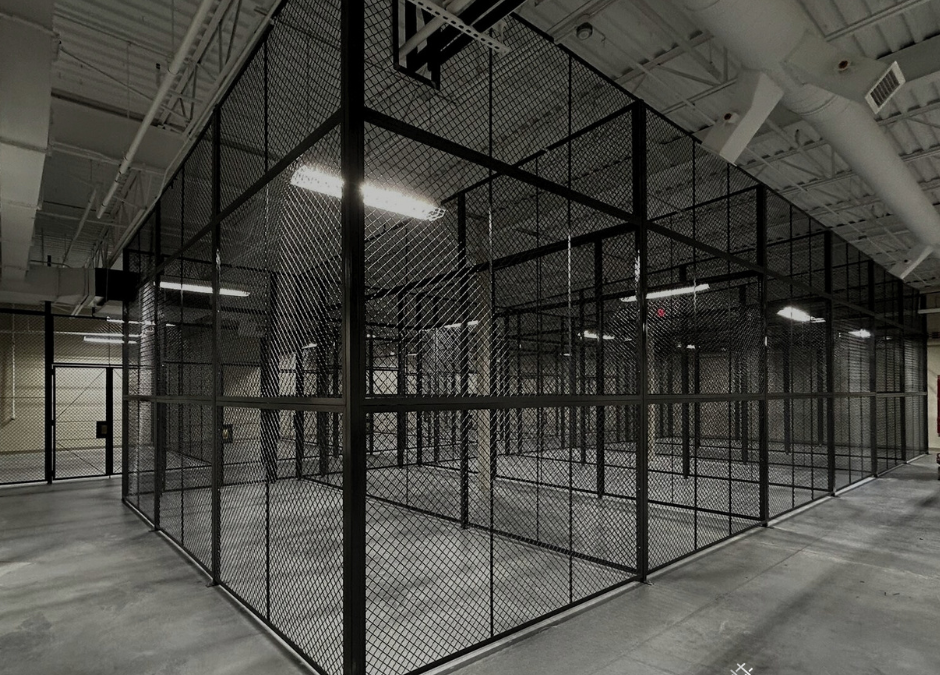
What Makes a Wire Mesh System “High Security”?
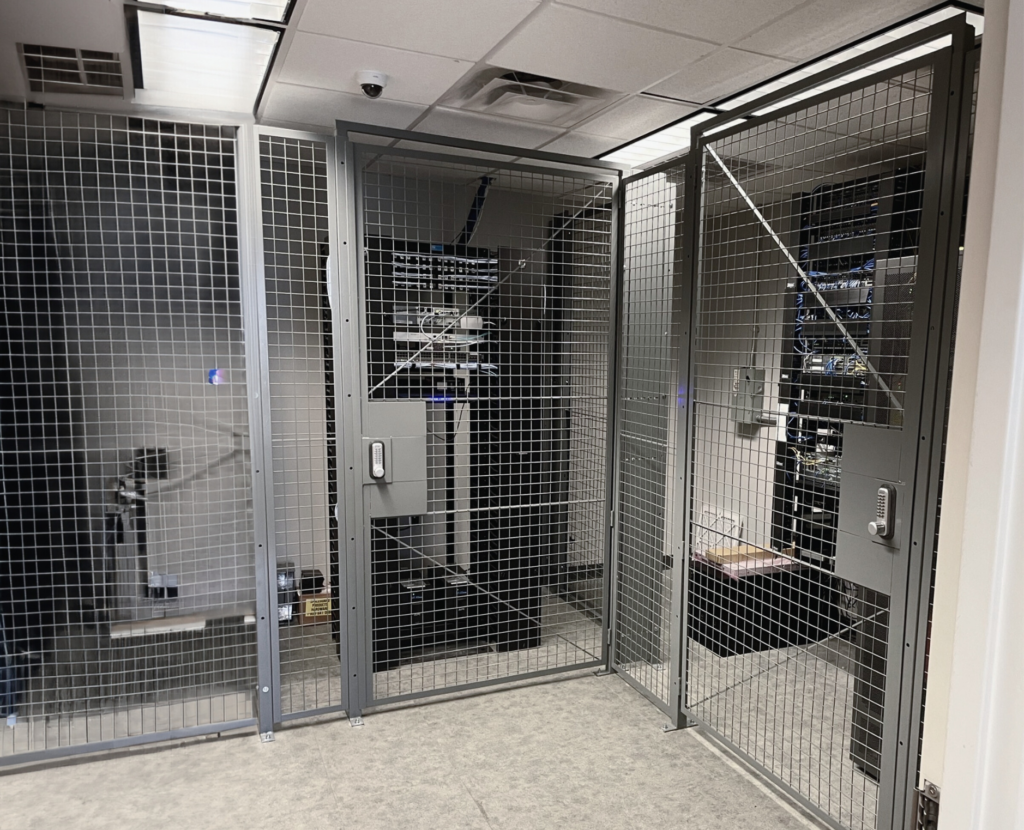
When most people think about security caging, they picture a basic wire enclosure — something to separate areas or discourage casual access. But there is a significant difference between a standard wire mesh partition and a system that is genuinely engineered for high security.
High security is not a marketing label. It is the result of deliberate engineering decisions — from the gauge of the wire to the anchoring hardware in the concrete floor.
So what truly separates a standard partition from a high-security wire mesh system?
Below are the defining factors.
Heavy-Gauge Wire and Mesh Pattern
The foundation of any wire mesh system is the wire itself.
High-security applications require heavier gauge welded wire — commonly 4-gauge or 6-gauge steel — compared to the lighter 10- or 12-gauge mesh often used in basic partitions. Thicker wire is dramatically more resistant to cutting, bending, and manipulation without industrial-grade tools.
Mesh pattern is equally critical. Tighter openings such as 2” x 2” (or smaller in specialized applications) prevent reach-through access and reduce the ability to manipulate locks, tools, or stored items from outside the enclosure.
Larger mesh openings may be acceptable for light-duty storage, but they introduce vulnerabilities in high-risk environments.
True security starts with steel thickness and grid design.
Welded Panel Construction and Frame Reinforcement
In high-security systems, mesh intersections are fully welded — not woven or mechanically fastened. Welded panels resist spreading and deformation under force, making them significantly stronger than woven alternatives.
Equally important is panel framing.
High-security systems use heavy-gauge steel tube or angle frames surrounding each panel. These frames provide rigidity and prevent flexing, prying, or distortion of the mesh under pressure.
Poor weld quality and lightweight framing are among the most common failure points in lower-grade systems. Consistent welds, corrosion-resistant finishes, and reinforced panel construction are non-negotiable in serious security applications.
Post Strength and Anchoring
Even the strongest mesh panel can fail if the supporting structure is weak.
High-security wire mesh systems utilize heavy-wall steel posts sized appropriately for the enclosure height and load requirements. Posts are secured with reinforced floor plates and anchored directly into concrete slabs using heavy-duty hardware.
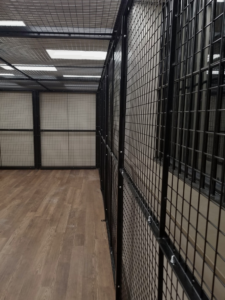
Improperly spaced, lightweight, or inadequately anchored posts can be pushed, leveraged, or destabilized — compromising the entire enclosure.
Anchoring integrity is one of the most overlooked — yet most critical — elements of a secure installation.
Full-Height and Ceiling Coverage
Many standard partitions stop short of the structural ceiling, leaving open space above.
If the application involves high-value inventory, pharmaceuticals, sensitive equipment, controlled substances, or restricted environments, full ceiling coverage is essential.
Without a ceiling panel, an enclosure can be bypassed using ladders or climbing methods.
High-security systems incorporate matching heavy-gauge welded wire ceiling panels or solid roof systems to eliminate overhead vulnerabilities. Panels extend continuously from floor to ceiling, removing bypass opportunities.
A security system is only as strong as its weakest access point — and overhead gaps are common weaknesses in non-secure installations.
Door Construction and Locking Hardware
The door is the most frequently targeted component of any enclosure.
High-security wire mesh systems use doors constructed to the same specifications as the surrounding panels, reinforced with heavy-duty hinges — often equipped with security pins to prevent removal.
Locking hardware should match the threat level of the application and may include:
-
Commercial-grade padlock hasps
-
Deadbolt systems
-
Multi-point locking mechanisms
-
Electronic access control integration
-
Keypad or badge reader systems
Lightweight slide latches and basic padlock loops are not suitable for high-security environments.
Access control is not an afterthought — it is engineered into the system.
Tamper-Resistant and Anti-Pry Features
In higher-risk environments, additional protective measures are incorporated into the design.
These may include:
-
Tamper-resistant fasteners
-
Concealed or internally mounted hardware
-
Anti-pry seams between panels
-
Reduced gap tolerances
-
Anti-climb ceiling configurations
Flat-top or inward-angled ceiling panels can eliminate footholds, while tight panel connections prevent leverage tools from being inserted.
Security is achieved not just through strength — but through eliminating exploitable gaps.
Compliance, Certifications, and Industry Requirements
In regulated industries, high security must be validated — not assumed.
Depending on the application, systems may need to meet requirements such as:
-
DEA cage specifications for pharmaceutical storage
-
UL-listed components
-
Industry-specific security standards
-
Insurance-mandated physical protection requirements
-
Government or municipal facility guidelines
Compliance ensures the system meets independently verified criteria rather than relying solely on manufacturer claims.
For facilities storing controlled substances, sensitive data, or high-value assets, meeting regulatory standards is often mandatory.
Standard Partition vs. High-Security System
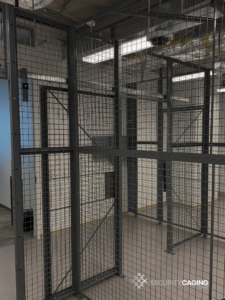
A standard wire mesh partition is designed for organization and separation.
A high-security wire mesh system is engineered for protection.
The differences include:
-
Heavy 4- or 6-gauge welded wire vs. light-gauge mesh
-
Fully welded construction vs. woven panels
-
Reinforced framing vs. minimal support
-
Heavy-wall anchored posts vs. light structural members
-
Full ceiling enclosure vs. open-top design
-
Commercial or electronic access control vs. basic padlocks
-
Compliance validation vs. general-use installation
The distinction is structural — not cosmetic.
When Should You Specify a High-Security Wire Mesh System?
High-security systems are appropriate when:
-
Storing high-value inventory
-
Protecting pharmaceuticals or controlled substances
-
Securing evidence or sensitive materials
-
Managing multi-tenant environments
-
Protecting data center infrastructure
-
Meeting insurance or regulatory requirements
If cutting, prying, climbing, or forced entry are realistic risks, a standard mesh partition may not provide sufficient protection.
The Bottom Line
High security in a wire mesh system is not defined by appearance — it is defined by engineering.
Wire gauge, welded construction, reinforced framing, secure anchoring, ceiling coverage, tamper-resistant hardware, and compliant access control all work together to create a secure enclosure.
When evaluating options for your facility, do not compare price alone. Compare construction methods, structural integrity, compliance standards, and installation quality.
At SecurityCaging.com, we specialize in wire mesh systems built for real-world security demands. From DEA-compliant pharmaceutical cages to high-value inventory enclosures and data center security partitions, our systems are engineered to perform under serious security requirements.
Contact us today to discuss the right high-security wire mesh solution for your facility.