What Is Tenant Storage and Why Are Developers Installing It in Every New Multifamily Building?
August 10, 2026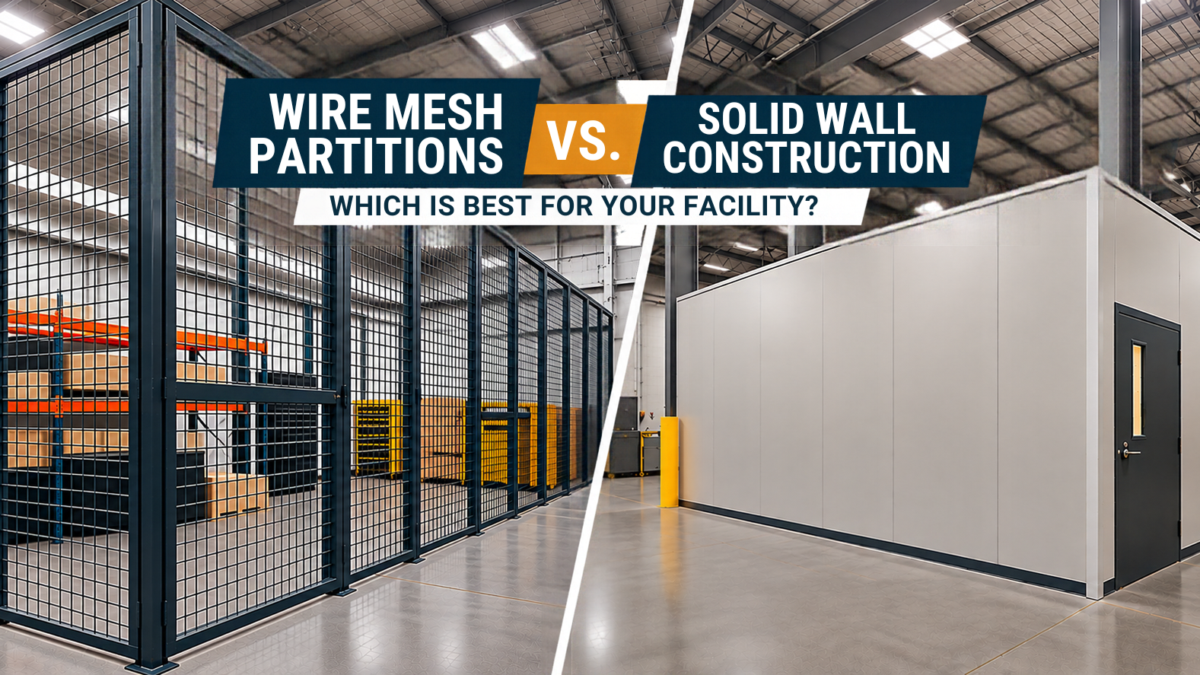
Wire Mesh Partitions vs. Solid Wall Construction: Which Is Best for Your Facility?
When it comes to securing valuable equipment, inventory, and restricted areas, choosing the right partition system is an important decision for any facility. Two common options are wire mesh partitions and traditional solid wall construction. While both provide physical separation, they offer different advantages in terms of security, airflow, visibility, installation, and long-term flexibility.
For warehouses, distribution centers, manufacturing facilities, data centers, and commercial buildings, understanding these differences can help facility managers and business owners select a solution that meets their operational needs.
In this guide, we’ll compare wire mesh partitions and solid wall construction to help you determine which option is best for your facility.
What Are Wire Mesh Partitions?
Wire mesh partitions are modular steel panel systems designed to create secure, enclosed areas within an existing facility. These systems typically consist of steel frames, welded wire mesh panels, doors, and locking hardware.
Unlike permanent walls, wire mesh partitions create physical separation while maintaining an open design that allows visibility and airflow throughout the surrounding space.
Common applications include:
- Warehouse inventory cages
- Tool and equipment storage
- Data center and server cages
- Manufacturing security enclosures
- Tenant storage lockers
- Distribution center security
- Restricted-access storage areas
- Commercial and industrial facilities
At SecurityCaging.com, we provide customizable wire mesh partition systems designed to accommodate a wide range of commercial and industrial storage requirements.
What Is Traditional Solid Wall Construction?
Traditional solid wall construction involves permanent or semi-permanent structures typically constructed using drywall, concrete, masonry, or other solid building materials.
These walls provide complete visual separation and may offer additional benefits such as sound reduction, environmental isolation, and fire-rated construction when properly designed.
Solid wall construction is commonly used for offices, conference rooms, mechanical rooms, private workspaces, and areas requiring controlled environmental conditions.
Although effective for many applications, traditional walls may introduce additional construction requirements, particularly when installed inside an existing warehouse or industrial facility.
Wire Mesh Partitions vs. Solid Wall Construction: Key Differences
Choosing between these two options depends on your facility’s security requirements, operating environment, available space, and future expansion plans.
| Feature | Wire Mesh Partitions | Solid Wall Construction |
| Security | Physical barrier with lockable access | Solid physical barrier |
| Visibility | Open visibility through mesh | Limited or no visibility |
| Airflow | Allows air circulation | Restricts airflow |
| Installation | Modular assembly | Often requires additional construction |
| Relocation | Many systems can be reconfigured | Typically difficult to relocate |
| Customization | Multiple panel sizes, doors, and layouts | Custom construction options |
| Maintenance | Generally low maintenance | Depends on wall materials |
| Fire Separation | Not a substitute for rated walls | Can be designed for fire-rated assemblies |
| Cost | Often economical for open security enclosures | Varies with materials and construction requirements |
Let’s explore the differences in greater detail.
1. Security: Which Option Provides Better Protection?
Security is often the primary consideration when selecting a partition system.
Wire mesh partitions provide a durable physical barrier that helps prevent unauthorized access to designated areas. Lockable doors and compatible access-control hardware can further improve security.
Their open design also allows supervisors and security personnel to monitor equipment and inventory without entering the enclosure.
This makes wire mesh partitions particularly useful for warehouses, manufacturing facilities, and distribution centers where visibility and controlled access are important.
Traditional solid wall construction, on the other hand, provides complete visual separation and can be appropriate for spaces requiring privacy, confidentiality, or specialized protection.
The best choice depends on the specific assets being protected and the level of security required.
2. Airflow and Ventilation
One of the most significant advantages of wire mesh partitions is their ability to maintain airflow.
In large industrial facilities, ventilation is essential for maintaining comfortable working conditions and supporting equipment operation.
Because wire mesh partitions use an open-grid design, air can circulate through the enclosure rather than being blocked by solid walls.
This is particularly beneficial in:
- Data centers and server rooms
- Climate-controlled warehouses
- Manufacturing facilities
- Equipment storage areas
- Commercial wine storage facilities
Traditional solid wall construction creates enclosed spaces that may require additional ventilation, heating, or cooling considerations.
For facilities where airflow is a priority, wire mesh partitions often provide a practical advantage.
3. Installation Time and Construction Disruption
Installation requirements can have a significant impact on facility operations.
Traditional walls may require framing, drywall installation, finishing, painting, and coordination with electrical or mechanical systems.
Depending on the project, construction can interrupt daily operations and create additional labor requirements.
Wire mesh partitions are typically manufactured as modular panels that can be assembled on-site.
This approach can offer several advantages:
- Faster installation for many applications
- Reduced construction debris
- Less disruption to surrounding operations
- Simplified expansion or reconfiguration
- Reduced need for extensive finishing work
For active warehouses and distribution centers, minimizing downtime can be especially valuable.
4. Cost Considerations
Cost is another important factor when comparing wire mesh partitions and traditional solid wall construction.
The total cost of either solution depends on the size of the project, materials, installation requirements, security features, and existing building conditions.
Wire mesh partitions may offer cost advantages because they typically require fewer finishing materials and can be installed using modular components.
Traditional walls may involve additional expenses related to framing, drywall, painting, mechanical modifications, and other construction work.
However, costs should always be evaluated based on the specific application.
For facilities that primarily need physical separation and controlled access, wire mesh partitions can provide an economical alternative to permanent construction.
5. Flexibility and Future Expansion
Facility layouts rarely remain unchanged forever.
As businesses expand, relocate equipment, or introduce new operations, storage and security requirements often evolve.
Modular wire mesh partitions offer flexibility because many systems can be disassembled, relocated, expanded, or reconfigured.
This makes them especially useful for businesses anticipating future growth.
Traditional solid wall construction is generally more difficult to modify. Relocating or removing permanent walls may require demolition, reconstruction, and additional permitting.
For facilities that value adaptability, modular wire mesh partitions can provide a significant long-term advantage.
6. Visibility and Inventory Management
Visibility plays an important role in warehouse efficiency and inventory control.
Wire mesh partitions allow employees and supervisors to see stored materials, equipment, and inventory without opening the enclosure.
This can help facilities:
- Monitor inventory more efficiently
- Identify stored equipment quickly
- Improve accountability
- Maintain visual oversight of restricted areas
- Reduce unnecessary access to secured spaces
Traditional solid wall construction blocks visibility unless windows or other viewing features are incorporated.
For facilities that prioritize operational efficiency alongside security, wire mesh partitions offer an effective combination.
7. Maintenance and Long-Term Durability
Commercial and industrial facilities require materials capable of withstanding demanding environments.
Steel wire mesh partitions are designed for durability and generally require limited routine maintenance.
Depending on the system and application, protective finishes such as powder coating can help improve resistance to everyday wear.
Traditional walls may require periodic painting, drywall repairs, or other maintenance depending on their construction and exposure to equipment traffic.
Both systems can provide long service lives when properly specified, installed, and maintained.
When Should You Choose Wire Mesh Partitions?
Wire mesh partitions are often the better choice when a facility requires:
- Secure storage with controlled access
- Visibility into enclosed areas
- Continuous airflow
- Modular construction
- Flexible layouts
- Future expansion capabilities
- Minimal disruption during installation
These advantages make wire mesh partitions particularly suitable for warehouses, distribution centers, manufacturing plants, data centers, and commercial storage environments.
When Is Traditional Solid Wall Construction the Better Option?
Although wire mesh partitions provide numerous benefits, traditional solid wall construction remains the appropriate solution for certain applications.
Solid wall construction may be preferable when a facility requires:
- Complete visual privacy
- Acoustic separation
- Fire-rated assemblies
- Controlled environmental isolation
- Specialized room construction
- Permanent separation between occupied spaces
For example, an office or conference room typically requires more privacy and sound control than a warehouse inventory cage.
Similarly, areas requiring fire-rated separation must use assemblies that meet applicable building and fire code requirements.
Wire mesh partitions should not be considered a replacement for required fire-rated or smoke-rated walls.
Can Wire Mesh Partitions and Solid Wall Construction Be Used Together?
Absolutely.
Many commercial and industrial facilities benefit from combining both solutions.
For example, a warehouse may use traditional walls for administrative offices while installing wire mesh partitions around valuable inventory, equipment, and restricted storage areas.
Wire mesh partitions can also be configured alongside existing building walls, allowing facilities to create secure enclosures without constructing four entirely new walls.
This approach can maximize existing space while providing security where it is needed most.
Frequently Asked Questions About Wire Mesh Partitions
Are wire mesh partitions as secure as traditional walls?
Wire mesh partitions provide a durable physical barrier and can incorporate locking hardware and access-control systems. However, security depends on the specific design, materials, installation, and threat requirements. Traditional walls may be more appropriate where complete concealment or specialized protection is necessary.
Are wire mesh partitions cheaper than drywall?
Wire mesh partitions can be more cost-effective for many industrial security applications because they use modular components and typically require less finishing work. Actual costs depend on project size, specifications, and installation conditions.
Can wire mesh partitions be relocated?
Many modular wire mesh partition systems can be disassembled and reconfigured or relocated, depending on the design and condition of the components.
Do wire mesh partitions require building permits?
Permit requirements vary by location, facility, and application. Property owners should confirm applicable building codes, fire regulations, and permitting requirements before installation.
Can wire mesh partitions be customized?
Yes. Wire mesh partitions are available in various configurations, dimensions, panel styles, finishes, door options, and locking arrangements to accommodate different facility requirements.
What industries use wire mesh partitions?
Wire mesh partitions are commonly used in warehousing, manufacturing, distribution, data centers, multifamily housing, commercial storage, and other industrial applications.
Choosing the Right Partition System for Your Facility
There is no single partition system that works best for every application.
Traditional solid wall construction remains essential for spaces requiring privacy, environmental separation, or specific building-code performance.
However, when the primary goal is to secure equipment, inventory, or restricted areas while maintaining airflow, visibility, and flexibility, wire mesh partitions are often the more practical solution.
Their modular construction, customizable configurations, and durable steel design make them an effective option for facilities looking to improve physical security without unnecessary permanent construction.
Secure Your Facility with SecurityCaging.com
At SecurityCaging.com, we understand that every facility has unique security and storage requirements.
Our wire mesh partition solutions are designed to help businesses create secure, organized, and functional spaces while maintaining the flexibility needed for changing operations.
Whether you’re planning a warehouse security enclosure, equipment cage, tenant storage system, or custom industrial partition, we can help you identify a solution suited to your facility.
Ready to improve security and maximize your facility’s available space?
Visit SecurityCaging.com to explore our wire mesh partition solutions and request information for your next project.